The Hague Apostille and Document Legalisation in Andorra
The Hague Apostille and Document Legalisation in Andorra
Author: Raquel Cornejo
In an increasingly globalised world, the authentication of official documents is essential to ensure their legal validity across different jurisdictions.
In Andorra, foreign documents are frequently required for immigration procedures, residence applications, business incorporation, investment projects, notarial transactions and a wide range of administrative processes.
For this reason, understanding how documents must be authenticated is crucial to ensure their official recognition before Andorran authorities.
What Is the Hague Apostille?
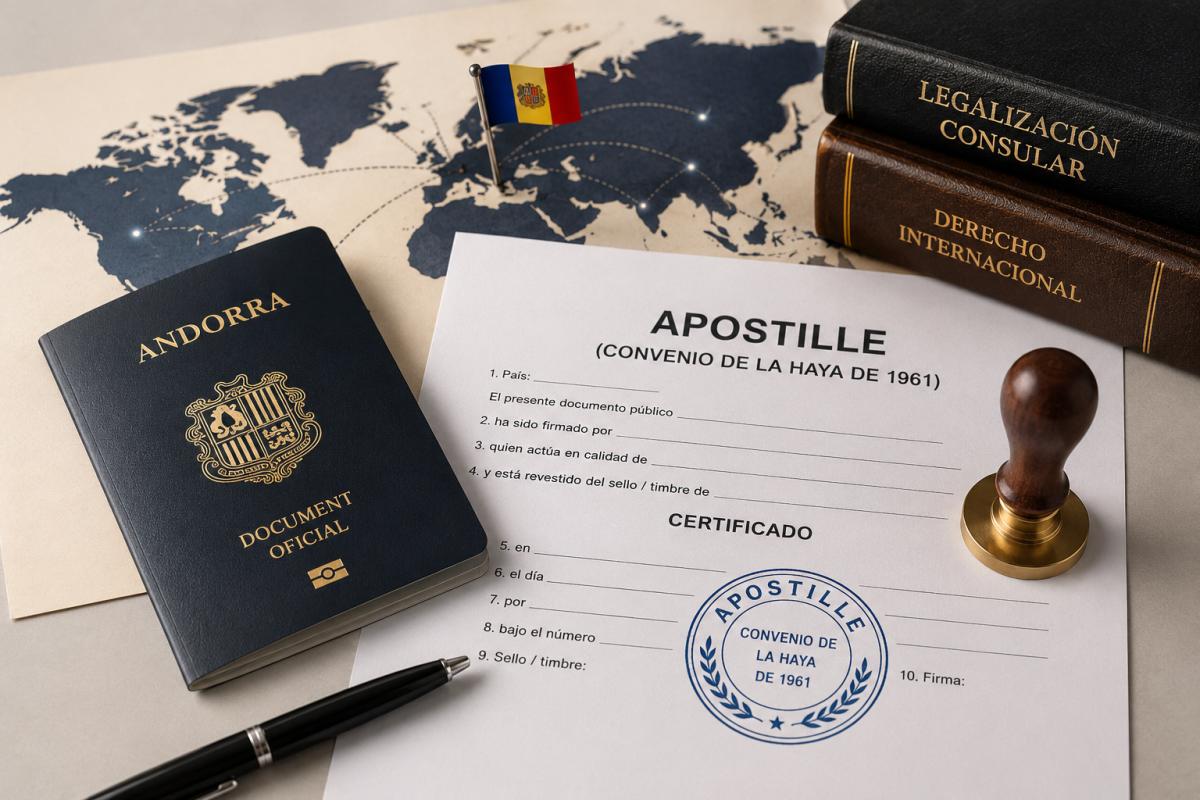
The Hague Apostille is a simplified document authentication system established under the 1961 Hague Convention.
Through this mechanism, public documents issued in one member state can be officially recognised in any other contracting state without the need for additional consular legalisation.
The Apostille commonly applies to documents such as:
Birth certificates.
Marriage certificates.
Notarial documents.
Court judgments.
Academic diplomas and certificates.
Its principal advantage is that a single certification stamp is sufficient to validate the document internationally.
Advantages of the Hague Apostille
The Apostille system offers significant benefits for both individuals and businesses:
Simplified administrative procedures.
Faster processing times.
Elimination of multiple consular certifications.
International recognition among Hague Convention member states.
As a result, it has become the preferred method for validating documents intended for use in participating countries.
When Is Consular Legalisation Required?
If the country where the document originates is not a member of the Hague Convention, the traditional consular legalisation process must be followed.
This procedure generally involves several stages:
1. Initial Certification
The document must first be certified by a competent authority in the country of origin, such as a notary public or government authority.
2. Consular or Diplomatic Legalisation
The signature of the issuing authority must then be authenticated by the relevant embassy or consulate.
3. Official Translation
Where the document is not issued in Catalan, Spanish or French, an official translation may be required.
How Can Andorran Documents Be Legalised for Use Abroad?
Documents issued by Andorran notaries, public authorities or other official institutions may also require legalisation before being recognised in another country.
The applicable procedure depends on the destination jurisdiction and must generally be processed through the Government of Andorra.
Practical Example of Consular Legalisation
Consider the case of a Spanish citizen residing in the Philippines who needs to submit documentation in Andorra.
The process would generally involve:
Initial certification by a local notary in the Philippines.
Authentication of the notary’s signature through the Spanish Embassy.
Translation and official recognition of the document in Andorra.
This example illustrates the complexity that may arise when dealing with documents originating from countries that are not party to the Hague Convention.
Practical Example of a Hague Apostille in Spain
In Spain, the competent authority depends on the type of document:
Notarial documents: Notarial Associations (Colegios Notariales).
Administrative documents: Government Delegations or Regional Authorities.
Academic documents: Ministry of Education followed by the Ministry of Foreign Affairs.
Identifying the appropriate authority is essential to avoid delays during the process.
Conclusion
Whether a document requires a Hague Apostille or consular legalisation depends on the country of origin and the country where the document will be used.
While the Apostille provides a fast and simplified solution for Hague Convention member states, consular legalisation remains necessary for documents originating from non-member countries.
Understanding these procedures helps avoid administrative delays, facilitates international transactions and ensures the full legal validity of documents across borders.
¿Necesitas asesoramiento?
Nuestro equipo está listo para ayudarte.
Artículos relacionados
Renewal of Residence and Work Permits in Andorra: Requirements and Necessary Documentation
The Importance of a Well-Drafted Will for Avoiding Inheritance Disputes